Meow Monitor · secondary-screen cyber rail

A small screen.
A little company.

A hand-drawn cat, a few hardware curves, and a place for your agents to check in. Meow Monitor puts the things worth a glance on a little USB screen beside your work.

Windows x64TURZX 8.8″Live telemetryLocal agent messages

One screen · two dashboard moods

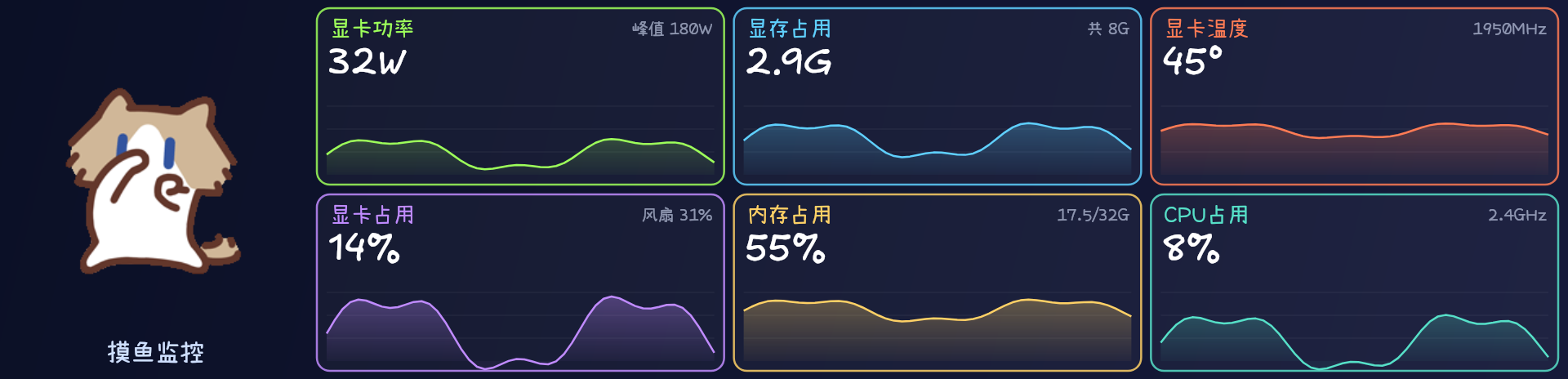
Meow Monitor dashboard with a hand-drawn cat and six colorful graphs for GPU power, VRAM, GPU temperature, GPU usage, memory, and CPU usage
01 / Dashboard preview

The original dashboard image from the project. Six hardware readings, one small companion. On a narrow screen, swipe across the preview to see every card.

Keep the useful things
at the edge of attention.

A GPU temperature does not need an entire window. A finished task does not always need another notification on the main display. Meow Monitor starts with a spare strip of screen space and gives these small signals somewhere to live.

The dashboard pairs large readings and recent trends with SalaryCat, a tiny animated coworker. Switch the left side to the cyber rail and the same screen becomes a place for scripts and agents to leave short reports while you keep working.

A little company while the machine works. A little signal when it needs you.

Six curves.
One quick glance.

GPU power, video memory, GPU temperature, GPU utilization, system memory, and CPU usage sit together as reorderable cards. Each pairs the current value with a rolling history, so a short spike and a sustained workload look different at a glance.

01 / Hardware

A little context

Colored curves show recent activity alongside the large numbers. NVIDIA GPU readings come from nvidia-smi; CPU and memory readings come from the local system.

02 / Companion

A softer interface

Handwritten labels and the animated SalaryCat give a hardware dashboard the feeling of a small desk companion.

A small command.
A visible handoff.

In cyber rail mode, the left side becomes a local message feed. A tool sends its name and a short update through the meow CLI. The screen shows the sender, time, and message, with an optional animated “叮!” when something new arrives.

meow "codex" "Build complete. Ready for review."

An example command: the tool or agent actively sends the report. The rail does not automatically watch every task.

01A tool finishes

Build, script, or agent

02meow sends

Local communication

03The rail shows it

A glance, then a decision

Delivery and visibility are separate. The CLI reports whether the message is on the screen now, stored while the rail is hidden, or unable to reach the running app. That distinction makes a completed task easier to hand back without assuming the user has already seen it.
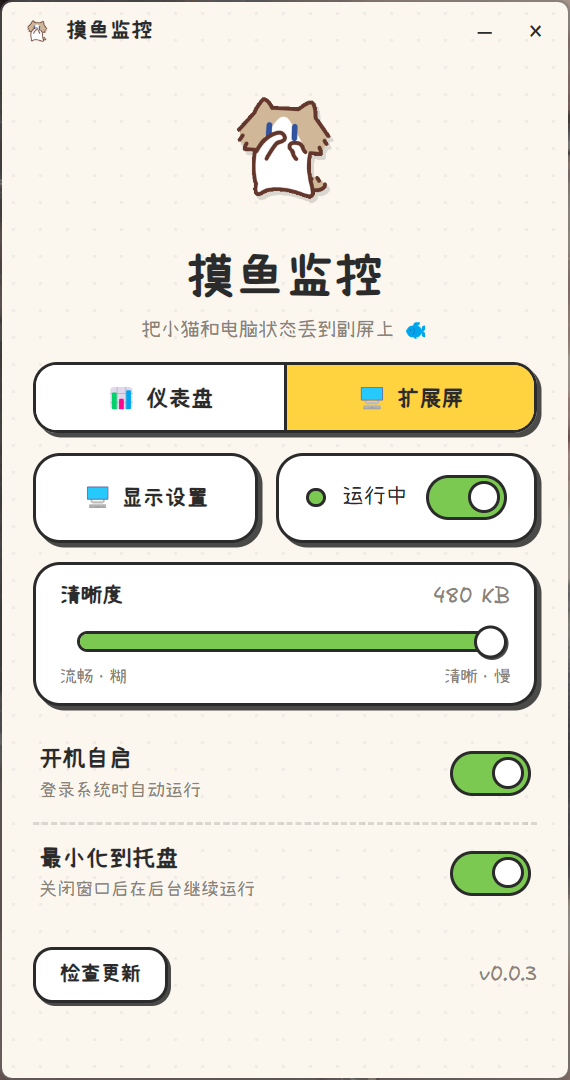
Meow Monitor's warm, hand-drawn control panel showing extended display mode, image quality, startup and system tray controls
Control-panel preview from the repository.

A small panel.
A second life.

The control panel keeps everyday choices close: start or stop the screen, choose the dashboard mode, adjust settings, and leave the app in the system tray.

01

Dashboard mode

Let the cat keep you company, or switch to the cyber rail for agent reports alongside hardware readings.

02

Extended display mode

A virtual Windows display gives the same USB panel another use: extra desktop space, captured and sent to the screen. This mode replaces the dashboard while it is active.

03

Settle into the background

Startup and tray settings let the little screen become part of the desk routine, with image-quality controls for the extended display.

Draw locally.
Send over USB.

An Electron control panel manages a Node.js rendering engine. The engine collects hardware readings, draws a 1920 × 464 canvas, rotates it to the panel’s native orientation, and sends image frames through an open-source USB driver. The TURZX vendor application is not needed to draw the dashboard.

The cyber rail uses local inter-process communication. Extended display mode uses MttVDD to create a virtual display and forwards its captured image to the panel.

8.8″TURZX USB panel
6hardware cards
Localrendering & messages

Built for Windows x64 and the TURZX 8.8-inch panel (VID 0x1CBE / PID 0x0092). GPU telemetry requires NVIDIA’s nvidia-smi. The official screen software must be closed so the app can access the USB device.

A tiny part of the desk.

Meow Monitor is a personal, open-source experiment in making computer activity feel a little more tangible: a cat to share the day, curves to show the workload, and a rail for the moments worth reporting.

Dashboard and control-panel images come from the project. SalaryCat artwork by Einswen / SalaryCat. Other component credits are documented in the repository.